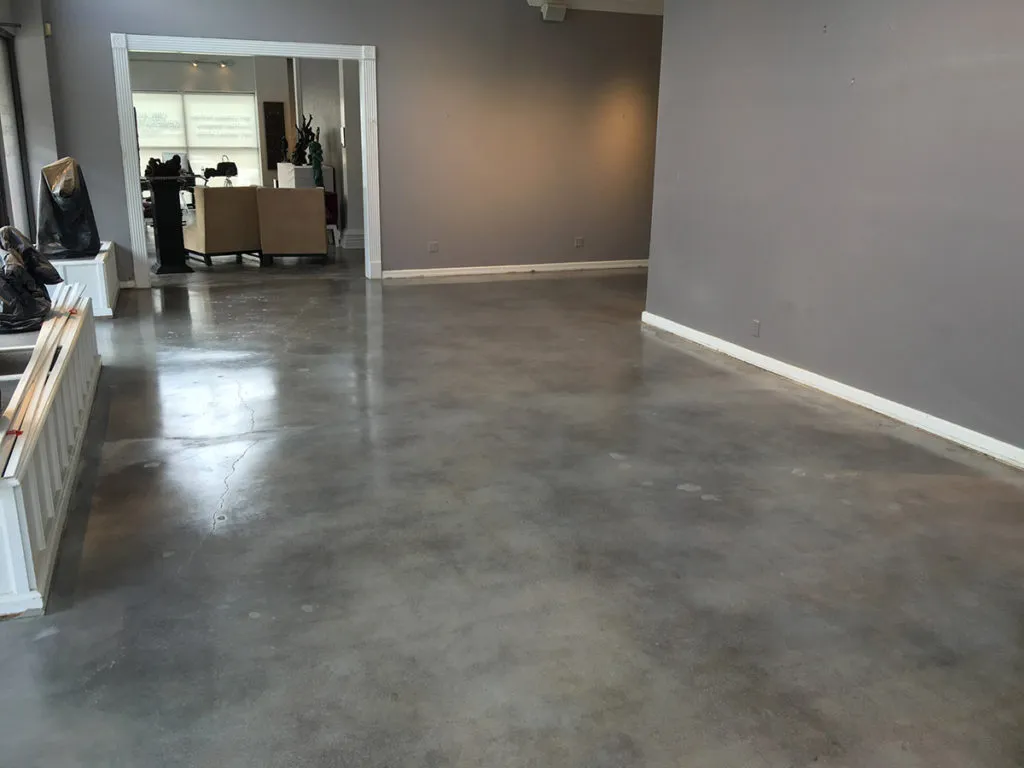
Hairline cracks and some color variation are normal in new concrete. Wide cracks, ponding, a surface that sheds flakes and a slab draining toward the building are defects. In the Inland Empire, heat and dry wind on pour day sit behind many of them.
Why is my new concrete already cracking?
Because concrete shrinks while it hardens. Joints are placed so that the shrinkage crack hides inside them. Short, shallow cracks that show up the same afternoon are plastic shrinkage cracks, and a hot day with a Santa Ana blowing is exactly when they form, since the top dries before the body of the slab. Be more concerned by cracks that are wide, stepped, or running well away from any joint; those suggest the base, the joint spacing or the cure.
Is the contractor responsible for a crack that appears weeks later?
That turns on the kind of crack and the wording of your contract. Nobody can guarantee crack-free concrete, and hairlines are excluded from most warranties. A contractor responsible for the job does answer for workmanship: base, thickness, joints and curing as promised. Take a photo with a ruler in it, write down the date and report it in writing. Read your contract and warranty before you talk.
Why does my new concrete have dark and light patches?
Dark and light areas come from uneven drying. A shaded strip stays darker than a strip in full sun, two truckloads rarely match exactly, and harder troweling darkens the surface. Most of this fades over the first months. Differences in the mix itself, or an accelerator added to one load only, can be permanent.
What happens if it rains on fresh concrete?
When it rains on fresh concrete that has not set, the rain dilutes the paste at the surface and can leave it soft, dusty or pocked. Once the surface has hardened, rain is harmless. Our rain is concentrated in winter, with the occasional summer thunderstorm off the mountains, so those are the days we cover a pour or move it. To test a slab that got wet, rub it hard with your hand a week later and see whether it powders.
I see footprints, rough areas and low spots, and the new pad looks out of level. What are my options?
Surface marks such as footprints and trowel ridges can generally be ground out and coated. Birdbaths and a pad that is truly out of level are tougher. Test with a hose and a straightedge. Some fall is intended, because a patio has to shed water away from the house. Water that stands, or runs to the wall, means that part needs correcting and possibly repouring. Send the contractor photos and a written description.
Are control joints really needed, and is it too late to saw-cut them a week later?
Control joints are needed on every slab, because they set where the crack goes. A saw-cut made a week later is nearly always too late. Joints get tooled into wet concrete or sawn as soon as the slab can carry the saw cleanly, normally within hours and no later than the following morning. Under our summer sun a slab can crack on its own before the next day. Have joint spacing, depth and timing written into the quote.
I found out afterward that my slab was poured without rebar or mesh. Is it a loss?
No, not automatically. Plenty of walks and patios poured without any reinforcement perform well on a firm base. Steel is there to hold a cracked slab together and flat, not to stop it cracking. Start with the contract. If steel was specified and paid for and is missing, say so in writing; a locator scan or pour-day photos will prove it. If nothing was specified, monitor the slab and keep vehicles off its edges.
My new stamped concrete is slippery. What fixes that?
A traction additive in the sealer fixes most slippery stamped surfaces. The gloss coat fills the texture, and a wet pool surround or a dewy winter morning does the rest. Fine polymer grit stirred into the next sealer coat adds grip and barely shows. It is a short return visit for the installer.
Why is my stamped concrete fading, cloudy or peeling?
A cloudy or white haze is moisture caught beneath the sealer, often from sealing too thickly or over a damp slab. Peeling is a bond failure. Fading is ultraviolet damage, and at our latitude and elevation the sun is strong for most of the year. Haze can often be cleared by re-dissolving the sealer with solvent. Faded work is cleaned and resealed, at times with a tinted product.
The surface started flaking in its first year. Is that expected?
It is not. Flaking in the first year, or after the first winter in a colder town like Yucaipa, means the top was weak from day one. On the valley floor, frost is seldom the reason. Look instead at water added during finishing, early troweling and missing cure in hot weather. Notify the contractor in writing right away and include the pour date and photos.
It was poured in extreme heat and looks bad. Is the weather to blame or the contractor?
Often both, though managing heat is the contractor's responsibility. Concrete poured in triple-digit heat stiffens quickly, so the crew has less time, and crusting, cracking and blotchy color become likely. Sensible practice is a dawn start, a wetted subgrade, a full crew, wind protection and immediate curing. A mid-afternoon summer pour with none of those is a workmanship issue.
The stamped pattern is crooked and the final balance is still unpaid. What should I do?
Put the defects in writing before deciding anything about the final payment. Photograph each one and ask for a written correction plan. The Contractors State License Board says that, except for the down payment, payments cannot exceed the value of the work performed. Withholding a sum that matches a documented defect is defensible. Withholding everything for a minor flaw tends to end in a claim against you. This is general information and not legal advice.
The crew left ruts, washout, splatter and the forms. Who deals with it?
The contractor should, when cleanup is in the contract, so make sure it is. Write down the ruts in the lawn, any washout slurry left on the ground or in the gutter, and splatter on stucco or the garage door. Splatter is easiest to remove in the first few days. Forms usually come off within a day or so. Left for weeks, forms bond to the edge and can chip it when pried away, so ask for them to be stripped promptly.
What can I do if the contractor will not come back to fix it?
When a contractor will not come back, send a dated written demand with a fair deadline and keep your contract, receipts, photos and messages together. California then offers these steps.
- Complain to the Contractors State License Board at cslb.ca.gov or 800-321-CSLB (2752). The board accepts complaints up to four years after the act or omission.
- Use the board's arbitration: mandatory for alleged damages of $25,000 or less, voluntary from $25,000 to $50,000.
- Look up the contractor's licence bond on the licence record; a claim can be made to the surety.
- Take a smaller money claim to small claims court, where you appear without a lawyer.
The board itself says its involvement does not guarantee restitution. An independent written assessment from another contractor strengthens any of these.