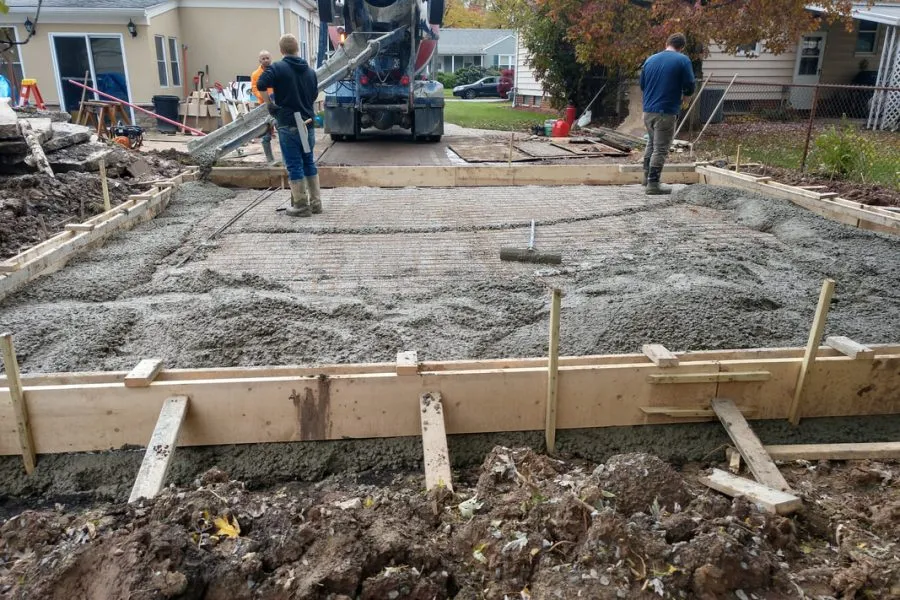
A typical driveway or patio is one or two days of preparation and one day of pouring. Foot traffic is fine after a day or two and cars after roughly a week. Locally, heat and dry wind are what the schedule bends around.
How long does concrete take to cure?
Rated strength is reached at about 28 days, though most of it arrives within the first seven. Curing means keeping moisture in, not letting it out. In our dry air a slab is kept wet, covered or coated with curing compound so the surface does not dry ahead of the rest.
How long before I can drive on new concrete?
Give it about 7 days before a car goes on. Hold off about a month for anything heavy: a motorhome, a moving van, a loaded trailer. For the first few weeks keep wheels away from edges and corners, where the slab has the least support.
How long before I can walk on new concrete?
One to two days is the normal wait for walking. Dogs, bicycles, hand trucks and trash carts should wait a bit longer, and nothing should be dragged over the surface during week one.
How long does it take to pour a driveway?
Placing and finishing is a single day. Ahead of that are one or two days to demolish, grade, compact and form. Allow extra time when the approach needs a city permit and inspection, and for the ready-mix slot. Counting from the first day on site to the first day you park, figure roughly ten days.
Can concrete be poured in the rain?
Not in steady rain, because water landing on unset concrete weakens the top. A shower after the surface is hard does nothing. Nearly all of our rain arrives from late fall through early spring, sometimes in heavy bursts, so winter jobs are booked against the forecast with plastic sheeting ready. Summer mountain thunderstorms occasionally spill into the valley, and we watch for those too.
Is it too hot to pour concrete in a San Bernardino summer?
No, as long as the day is planned around the heat. Past 100 degrees with single-digit humidity, moisture leaves the surface faster than it rises from below, which crusts and cracks the top. Summer pours therefore begin at dawn, the subgrade is wetted, trucks are spaced tightly, and curing follows the finishers across the slab. We skip the hottest afternoons altogether.
Do Santa Ana winds affect a pour?
Yes, as much as heat does. Santa Anas come down Cajon Pass warm, very dry and fast, mostly from fall into winter, and they can strip moisture off fresh concrete in minutes. On windy days we use wind screens and evaporation retarder, shrink the size of each placement, or reschedule. Blowing sand and leaves can also mar a wet surface.
Can concrete be poured in cold or freezing weather?
Yes. On the valley floor freezing nights are few, so cold mostly means a slower set and a later finishing time. Higher ground is different: Yucaipa and the foothill edges get regular frost and some snow, and there a new slab is insulated with blankets overnight and not poured ahead of a hard freeze. Fresh concrete should never freeze in its first couple of days.
What is the best time of year to pour concrete here?
The best time of year is spring, roughly March through May, with late fall close behind once the winds allow. Temperatures are moderate and storms are fewer. Summer is workable with dawn pours and winter is workable between storms. Crews pour year round in this valley, so your calendar and a calm, dry forecast matter most.
Can I use salt or deicer on new concrete?
Avoid both, and in the valley you will hardly ever want them. Salt and chemical deicer attack young concrete wherever it freezes, which is why owners in cold places are told to keep them off through the first winter. If you live up the hill in Yucaipa, or carry snow home from the mountains on your tires, use sand for traction. Rinse off water-softener salt and pool chemicals if they spill.
Need dates? Call (909) 306-5897. Your written quote lists the prep days, the pour day and the day you can park.