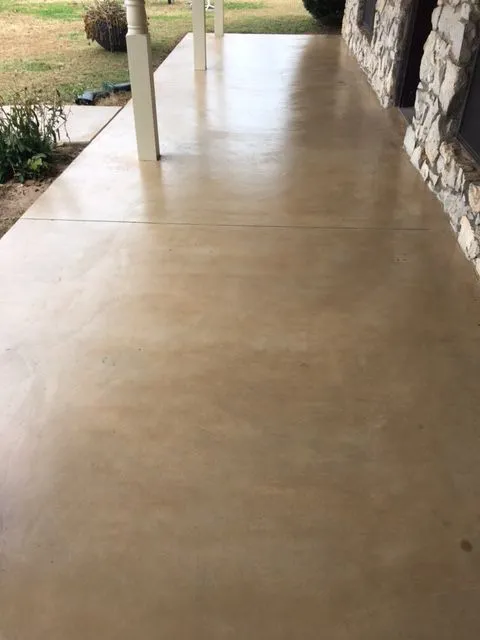
Flat concrete inside your lot line is often exempt from a building permit. Anything in the street right of way, meaning the sidewalk, curb, gutter and driveway approach, needs a City of San Bernardino permit first. What follows is drawn from state code, the municipal code and city pages. Rules get amended and lots differ, so we confirm the rule for your address before starting.
Do I need a permit for a driveway or patio in San Bernardino?
For flat work on private property you frequently do not need a permit. Section 105.2 of the California Building Code exempts sidewalks and driveways that are no more than 30 inches above adjacent grade, are not over a basement or story below, and are not part of an accessible route. That is an exemption from the building permit only. Zoning still applies. Patio covers, footings, slabs for buildings and taller walls are permitted work. Cities may amend the state code, so the City's Building and Safety Division has the last word.
Do I need a permit to widen my driveway?
Yes, if you widen the curb opening or the approach, because that is construction in the public right of way. Adding width only on your side of the property line is flatwork, yet front-yard paving and parking are governed by the Development Code. We have not verified San Bernardino's front-yard paving limits, so confirm with the Planning Division, or ask us to, before settling on a width.
Who owns the driveway apron, me or the city?
The apron, or driveway approach, lies in the public right of way in nearly every case, so the City decides what may be built there even though it serves your house. Municipal Code chapter 12.92 covers construction and maintenance of sidewalks, curbs and driveways. Who must pay to fix a worn approach at your address is a question to put to Public Works before you spend money.
Who is responsible for the sidewalk in front of my house?
You are, as the fronting owner. San Bernardino Municipal Code section 12.92.040 says owners of lots fronting a public street shall maintain any sidewalk and curb so that it will not endanger persons or property or interfere with public convenience. State law says the same in Streets and Highways Code section 5610. The City's Public Works page adds that the City makes concrete repairs as funds are available each fiscal year, that those funds are limited, and that the owner has ultimate responsibility.
The city sent a notice to fix the sidewalk. What now?
Find the deadline and the marked panels on the notice, then phone the office named on it. Under section 12.92.040 the owner must repair when the City finds a sidewalk or curb out of repair and dangerous. Ask which panels are included, what standard applies and whether the City plans to do any of it from its own repair budget. Then have those exact panels quoted in writing.
Do I have to use the city's contractor or can I hire my own?
In San Bernardino you can hire your own. The City's Public Works page states that an owner who cannot wait for a city repair may obtain a permit to have the damaged concrete repaired by a licensed contractor at the owner's expense. The work follows city standards and is inspected. Confirm the current steps with Public Works.
How close to the property line can I pour?
Flatwork may generally run to the property line. Leaving a margin is wiser. Your runoff must stay on your lot, the crew needs space for forms, and block-wall footings often project underground. Setbacks in the Development Code are aimed at structures and sometimes at parking. Unless a plan requires otherwise, we hold the slab back slightly and pitch it to drain on your side.
Do I need a survey?
Only when the pour follows a boundary that is in doubt. Block walls and fences in older tracts are often a foot or more off the true line. If the corner monuments are visible, or the slab is far from the edge of the lot, skip the survey. For a driveway or wall right on the line, having a licensed land surveyor set marks is cheap insurance.
Do I need HOA approval?
In an HOA, almost certainly. Associations in the newer tracts around Verdemont, Highland, Fontana and Rancho Cucamonga commonly review driveway widening, front walks, colored or stamped finishes and anything seen from the street. HOA approval and a city permit are two separate things. Have the approval letter in hand before a pour date is set.
How much of my lot can I cover with concrete?
Zoning rules on lot coverage and required landscaping set the limit, and adding impervious surface can raise storm-water questions. We have not verified a percentage for San Bernardino and will not print one. If you intend to pave most of a yard, ask the Planning Division what your zone allows, or give us the address and we will ask.
When does a retaining wall need an engineer or a permit?
The California Building Code requires a permit for a retaining wall more than 4 feet high measured from the bottom of the footing to the top of the wall, and for a wall of any height that carries a surcharge such as a driveway, a slope or a building. Since the measurement begins under the ground, a wall that shows only 3 feet can qualify. Permitted walls generally need drawings by an engineer, and in this seismic area the design includes earthquake loading. Hillside lots can also trigger grading review. Building and Safety confirms what applies.
How do I find underground utility lines before digging?
Call 811 or use digalert.org. DigAlert, formally Underground Service Alert of Southern California, is the free notification centre for this region. California Government Code section 4216.2 requires notice at least 2 working days before excavation, not counting the day of notice, and no more than 14 calendar days ahead. Outline the dig area in white first. Member utilities then mark their underground utility lines. A ticket stays valid for 28 days. Within 24 inches of either side of a marked line, only hand tools are used until the line is exposed. On our jobs, we place the ticket. Owner-installed lines, such as sprinklers, pool plumbing, yard lighting and a barbecue gas line, are not marked by anyone.
I need a wheelchair ramp and a wider walkway. Which rules apply?
At a private home, a ramp is designed around the person using it, and Building and Safety decides whether it needs a permit, mostly by its height and whether it serves a required exit. At a business, or housing open to the public, state and federal accessibility standards fix the slope, width, landings and handrails. No published price exists for ramps, so we quote them after measuring.
My home is in a historic area or has old decorative concrete. May I replace it?
Ask first. San Bernardino has many early 1900s homes, and nearby Redlands has designated historic districts where visible exterior changes can be reviewed. We have not verified how the City of San Bernardino treats walks and driveways on historic properties, so check with the Planning Division for your address. Old scored, stamped or tinted concrete can often be patched or reproduced in the same pattern.
Unsure which rule fits your lot? Call (909) 306-5897. Checking the permit question for your address is part of our estimate.